
We recently hosted a webinar pulling together insights from 50+ companies navigating the shift to pricing for AI and walked through what's actually changing and why the old playbook won't hold.
Here's a detailed breakdown:
The numbers are real. The margin problem is real.
AI spending is projected to hit $2.5 trillion by 2026. The use cases are no longer experiments. They're being productized and deployed at scale. But a lot of companies are scaling their AI spend without scaling their revenue to match. The correlation just isn't there yet, and it's showing up as margin compression.
Traditional SaaS companies at scale tend to operate at 80-90% gross margins. AI-native companies are landing at 50-60%. That gap isn't a minor one. It's a structural problem with how most of them are pricing and billing.
Why SaaS pricing breaks in the AI era
In traditional SaaS, infrastructure costs were mostly fixed. Adding a new user didn't move your cost structure much. You could price by seat, bundle features into tiers, and build a reasonably predictable business.
AI flips that entirely. Every user, every transaction, every token has a direct cost. One model can be 250x more expensive than another. Context windows grow silently. Vendor pricing shifts. What you charge needs to track what you spend, and in most companies today, it doesn't.
The result: companies are routinely losing money on individual customers without realizing it. A subscription with unlimited AI usage isn't a pricing model. It's a liability.
What the transition actually looks like
Across the 50+ companies we looked at, a pattern is starting to emerge. The ones successfully making this transition aren't reinventing pricing from scratch. They're finding the select few usage vectors that best reflect value delivered, tying revenue to it, and building from there.
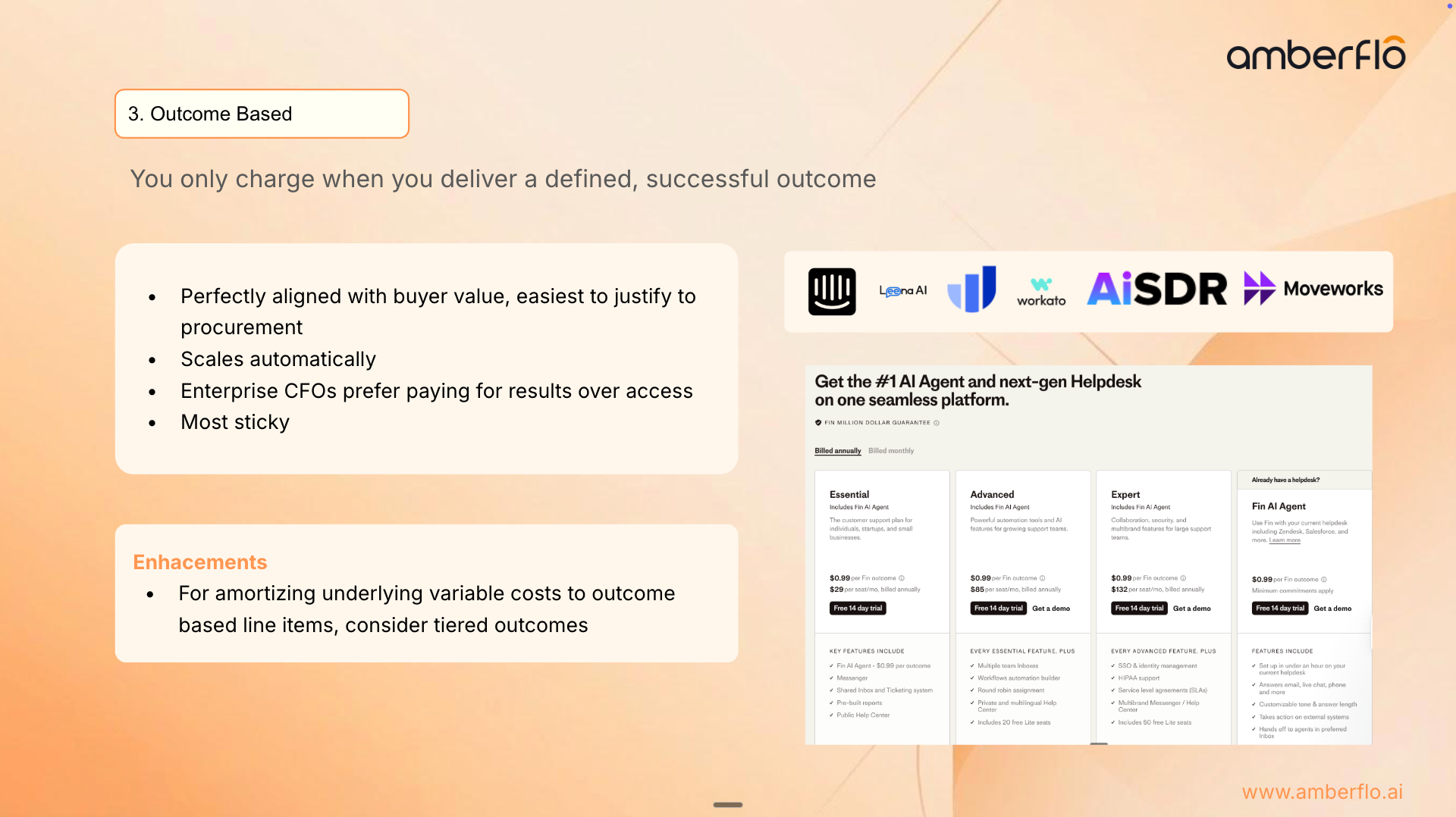
Intercom moved from seat-based to outcome-based pricing. They now charge $0.99 per resolved support ticket, with AI costs amortized into every resolution. The model is clean: the more tickets resolved, the more revenue generated. Customers aren't paying for access or seats. They're paying for results, and Intercom's revenue scales automatically as usage grows.

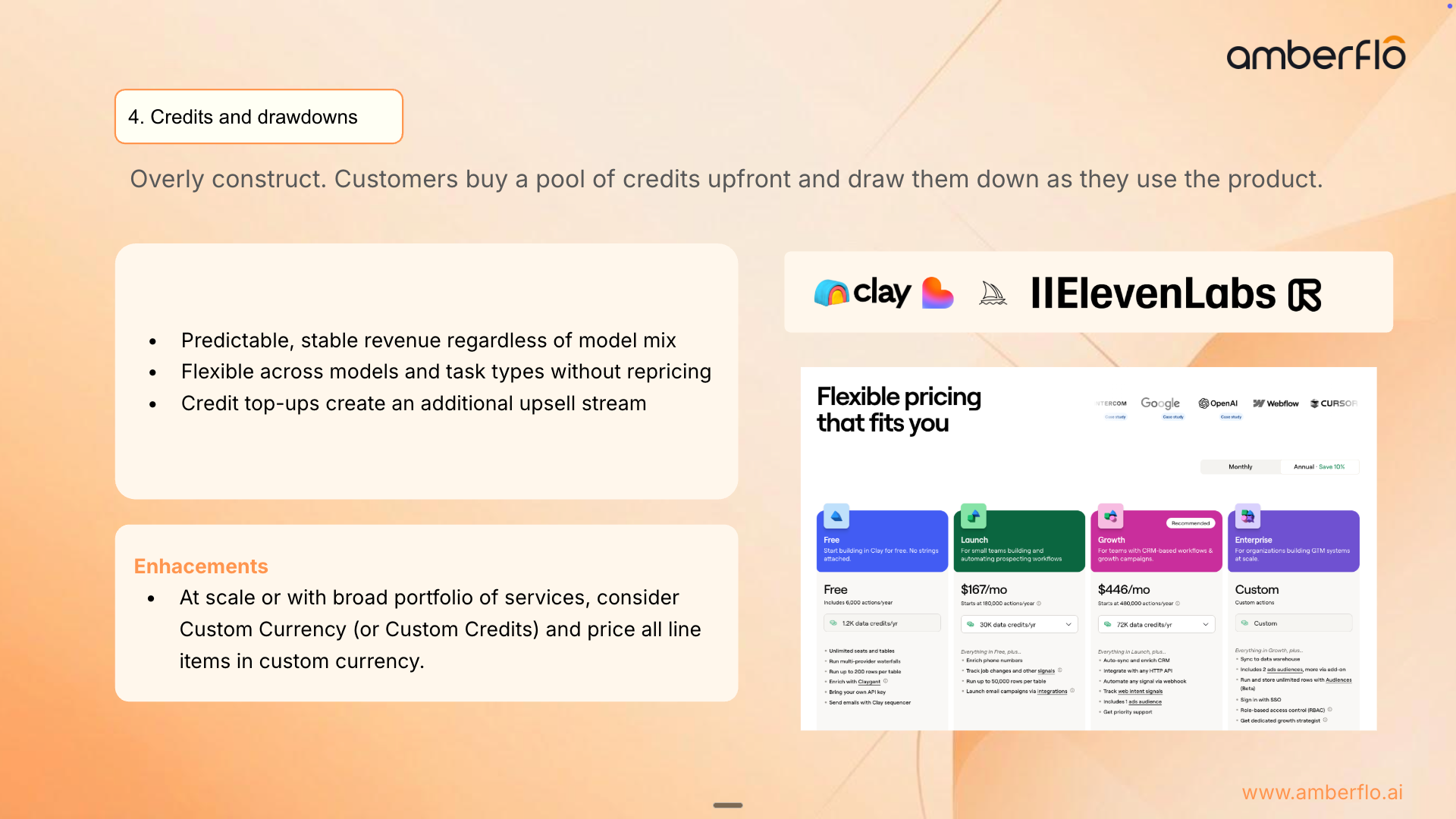
Apollo.io moved from fixed seats to a credit-based model. Customers subscribe to a plan that includes a pool of credits. Every product action, whether it's enriching a contact, running a sequence, or pulling data, draws down from that pool. When credits run out, customers top up. It aligns revenue directly with usage, creates a natural upsell motion, and doesn't require customers to understand what any individual action costs under the hood.

3 AI pricing models worth understanding
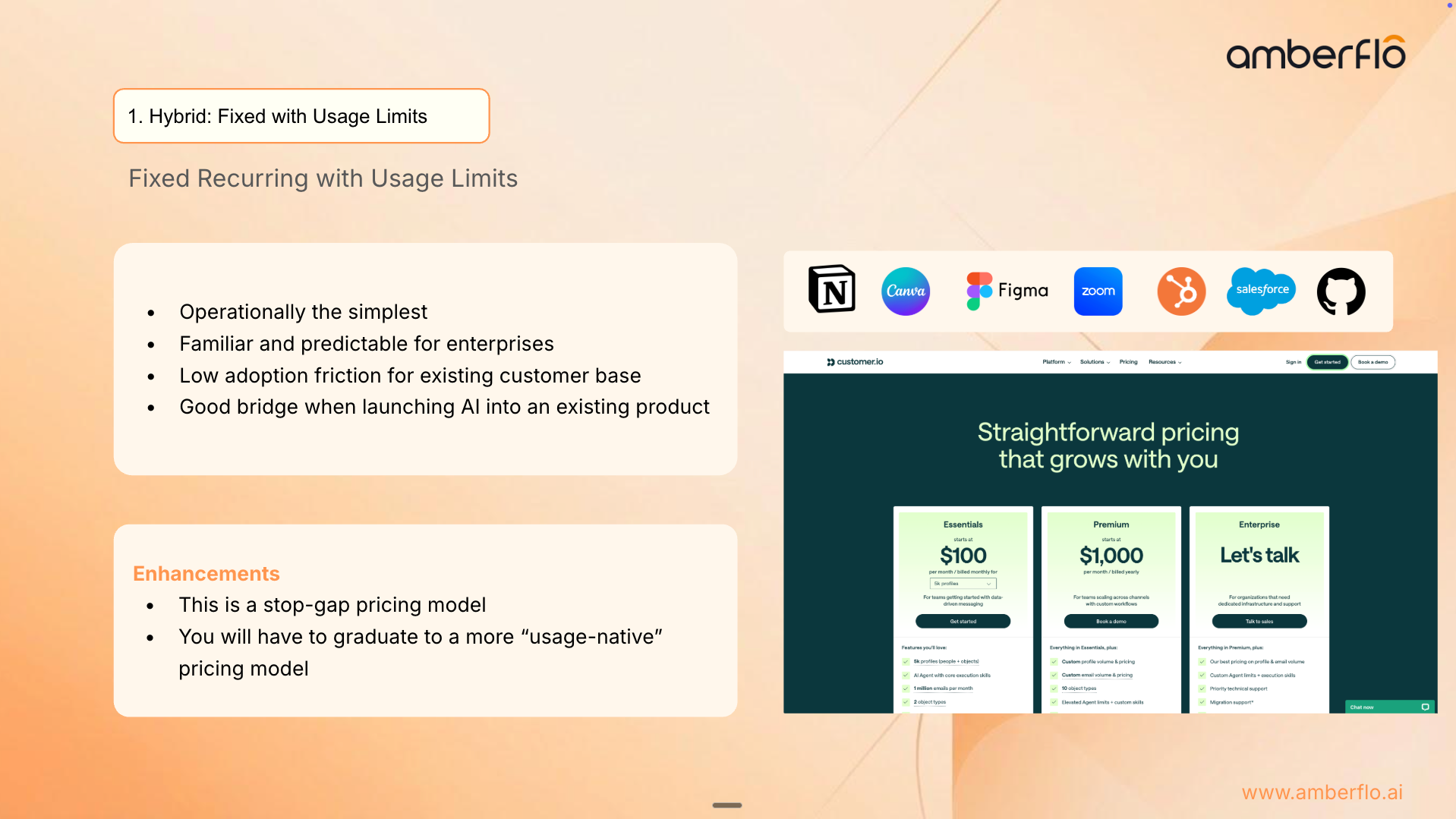
Hybrid is where most legacy SaaS companies start. You keep your existing subscription tiers but add usage limits on AI-dependent features. It's not a destination, it's a stepping stone. It buys you time to build internal tooling, develop operational discipline, and collect the usage data you'll need to move to something more sophisticated. If you're coming from a seat-based model, this is the lowest-friction entry point into usage-based pricing.
Usage-based is where you want to land. Customers pay for what they use, and your pricing scales automatically with your cost structure. Every user, every transaction, every token consumed maps directly to revenue. AWS pioneered this model and never looked back. The nuances around forecasting and customer visibility are real, but they're solvable with the right infrastructure. For AI-native companies especially, this is the model that most directly reflects how your costs actually behave.

Outcome-based is the stickiest model if your product supports it. Instead of charging for consumption, you charge for results. A resolved ticket. A closed deal. A generated output. Customers have no argument with the price because they're only paying when something works. It's also the hardest to instrument. You need clean, reliable tracking of those outcomes at scale. But if you can get there, it's the most defensible pricing model you can build.
Credits and drawdowns work as an overlay on top of any of the above. Customers buy a pool of credits upfront and draw them down as they use the product. For you, it means predictable, committed revenue regardless of which models or task types customers are consuming. For them, it means budget control and flexibility without needing to reprice every time your underlying model mix changes. Credit top-ups also create a natural upsell motion.
Choosing the right model for your situation
The right starting point depends on where you are today.
If you're an existing SaaS company adding AI features, start with hybrid: multiple plans, each with a fixed rate and usage limits on AI-dependent features. It lets you transition gradually without disrupting your existing customer base, and it buys you the usage data you'll need to move further.
If you're building an AI-native product from the ground up, every customer action costs you money. Usage-based pricing is where most AI-native companies land. Pricing scales automatically as usage scales, and prepaid credits handle long-term contracts and budget forecasting.
If you're early-stage and usage patterns are still unknown, start hybrid. Run it for 6 to 12 months, collect real usage data, and then shift to usage-based or outcome-based once you know where your cost drivers actually sit.
One rule applies regardless of which bucket you're in: meter everything from day one. You cannot build an effective pricing model without historical data to inform it.
3 mistakes to avoid
Pricing for average usage: AI usage is not a bell curve. One user uploads a 50-page PDF. Another chats for five minutes. Same feature, 100x cost difference. You cannot price for the middle and expect it to hold.
Copying your existing SaaS model: Seat-based or flat subscription pricing doesn't reflect AI cost structure. You end up subsidizing power users with revenue from light users. At scale, that's catastrophic.
Skipping metering and cost tracking: Real-time cost tracking is the prerequisite for AI pricing to work. Without it, you don't know which customers are profitable, which tiers are underwater, or where your margins are going. Cost tracking is part of AI billing infrastructure, not an optional layer on top of it.
The infrastructure required for AI pricing and billing
Choosing the right pricing model is only half the problem. The other half is having the infrastructure to actually run it. Most traditional billing solutions weren't built for this. Here's what you need.
Real-time metering: You need to know what every customer is consuming right now, not at month-end. Metering in the AI era isn't an analytics function. It's a financial system of record. If your metering is delayed or inaccurate, your invoices are too.
Cost attribution: Every LLM call, every token, every agent run needs to be tied back to the specific customer who triggered it. Without this, you're flying blind on which customers are actually profitable and which ones are quietly draining margin.
Margin visibility: Aggregate P&L tells you very little. You need gross margin at the customer level, in real time. That's the only way to know whether your pricing is working or whether you're growing revenue while shrinking margins.
Automated guardrails: Budget caps, spend alerts, and rate limits need to fire before problems compound, not after. If a customer's usage spikes or a credit pool depletes, your system should catch it automatically. Waiting for month-end reconciliation is too late.
Flexible billing engine: You should be able to launch usage-based, credit-based, or tiered billing without custom engineering every time. As your pricing evolves, your billing stack needs to keep up without a full rebuild.
Revenue recognition. Usage-based and credit-based models create complexity for RevRec. You need automated revenue schedules and ledger entries that work across both subscription and consumption-based plans, without manual intervention.
How Amberflo Closes the Gap Between AI Spend and Revenue
Amberflo is purpose-built for exactly this transition. The platform handles real-time metering, per-customer cost attribution, and flexible pricing support across all four models. You get automated metered invoicing, credit and drawdown management, margin visibility at the customer level, and guardrails that alert you when usage spikes or credits deplete. Whether you're migrating off a legacy billing stack or building usage-based pricing from scratch, Amberflo gives you the infrastructure to do it without stitching together five different tools.
Watch the full webinar and get the slides here. If you want to see how Amberflo can help you build the right pricing model for your AI product, book a demo.

.svg)

.svg)


.svg)
.svg)